NURS FPX 4025 Assessment 1 Analyzing a Research Paper
Student name
Capella University
FPX4025
Professor’s Name
Submission Date
Abstract
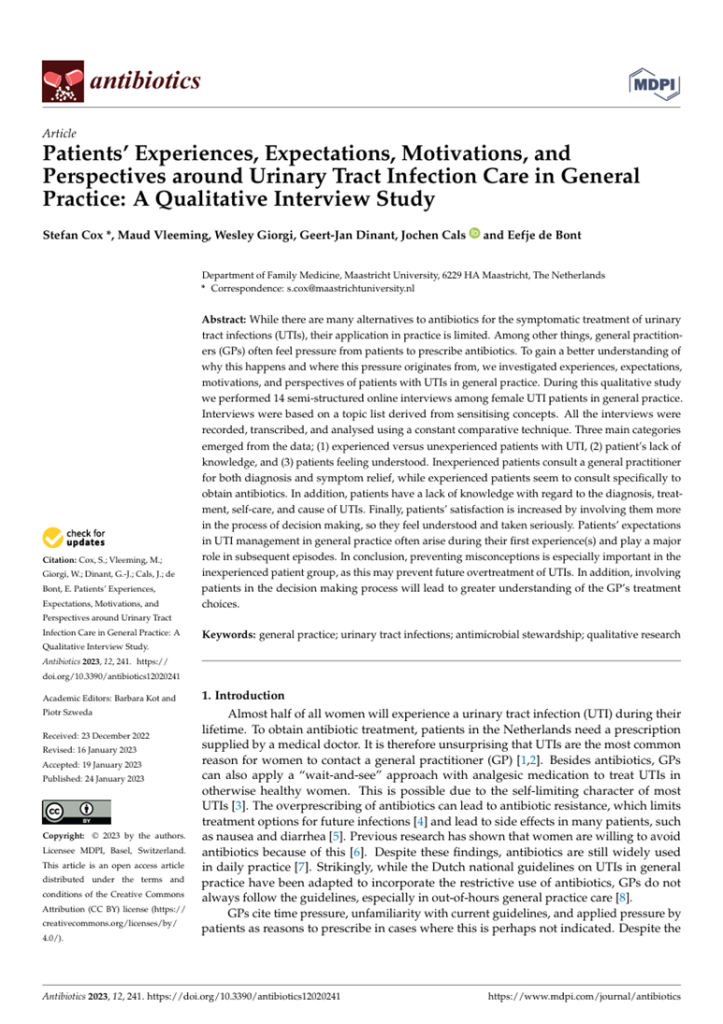
Figure 01
Abstract of Article
Keywords
Urinary tract infection (UTI); qualitative study; patient experiences; general practice; antibiotic expectations; symptom interpretation; communication; primary care; thematic analysis; patient perspectives.
References
Cox, S., Vleeming, M., Giorgi, W., Dinant, G.-J., Cals, J., & de Bont, E. (2023). Patients’ experiences, expectations, motivations, and perspectives around urinary tract infection care in general practice: A qualitative interview study. Antibiotics, 12(2), 241. https://doi.org/10.3390/antibiotics12020241
DOI
Published Date
February 2023
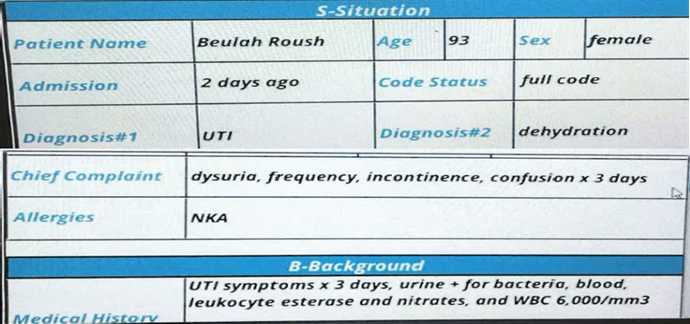
Figure 02
Sentinel U Patient Screenshot
| Criterion | Question | ||
| 1 | Precis of the kind of observe: The look at by using Cox et al. (2023) is a qualitative interview take a look at aimed toward exploring the experience, expectations, motivation, and perception of the patients in terms of the treatment of urinary tract contamination (UTI) in a widespread practice. The technique chosen by way of the researcher was once that of semi-structured interviews and it’s far worth noting that the members ought to describe their signs of UTI, worries, and expectations of their very own phrases with the assist of guided set of inquiries to be followed. This type of have a look at is appropriate whilst the researcher is inquisitive about getting the grasp and conduct of the humans in a detailed process, however now not generating the numerical information. The thematic analysis technique was used in the look at on the way to set up the important thing topics that display common styles within the revel in of patients. As a qualitative take a look at, it has the least at the proof hierarchy i.e., stage VI, i.e., descriptive and exploratory and now not experimental. but, it affords informative facts concerning verbal exchange, decision-making, and affected person-centered care, which can be the elements which might be notably applicable to the improvement of UTI control.. | ||
| 2 | Credibility of Article: the object is sound and it’s miles based on a number of essential educational dimensions. firstly, it has appeared in a scientific journal of an educational nature, published as Antibiotics, and this reality implies that its content has been undergoing a rigorous scrutiny by using the professionals prior to its guide. Peer evaluation may be useful in making sure that it is correct, pertinent and the technique is sound. 2nd, the studies authors are quite qualified and encompass no longer solely popular practitioners but additionally professionals inside the sphere of infectious disorder and medical researchers, the representatives of the primary care and antibiotic stewardship field. Their expert backgrounds assist to aid the trustworthiness and their relevance to the scientific practice. 1/3, the research has clear and strict technique. The authors virtually describe their sampling method, interview method, thematic coding procedure and moral approval. | ||
| 3 | Significance of content: that is an essential paintings because it will deal with one of the maximum critical questions in the fitness care surroundings- how sufferers understand the symptoms of UTI and how their expectations have an impact on their choice to receive remedy, mainly the system of taking antibiotics. Many sufferers want to be handled with antibiotics to therapy urinary symptoms no longer justified by using the medical condition and make contributions to the growing charge of antibiotic resistance. The take a look at suggests the vulnerabilities of the communication among the clinicians and patients, and misinformation about the symptoms, expectations and diagnostic methods can cause frustrations or incorrect remedy. Such patient perspectives would be of importance within the development of effective patient schooling interventions, shared selection making and reduction of irrelevant antibiotic prescriptions. The outcomes are in particular essential in geriatrics and lengthy-term care in which UTIs are typically diagnosed improperly on account of the overabundance or doubtful symptoms. typical, the item may be beneficial to permit greater efficient, affected person-centered, and evidence-based tactics to deal with UTI. | ||
| 4 | Capacity to use content to the administrative center: The findings of the modern-day studies may be at once translated into the medical practice immediately to the ones environments, in which the UTIs are dominant, consisting of hospitals, primary care centers, and nursing homes. The paper additionally emphasises the significance of open and open communication with the patient when it comes to the symptoms, diagnostic processes and the importance of the remedy. The information will as nicely assist the clinicians to inform the sufferers more on whether or not they need antibiotics or not, and whilst other management picks are relevant. this is specially authentic while dealing with older adults like Beulah Roush as passed off inside the case of the Sentinel U simulation and where the patient is predicated closely at the route of the clinician. The mentioned examine topics can assist nurses and providers to assume affected person worries, set up expectancies of realistic nature, and decrease the beside the point use of antibiotics. via the help of stepped forward conversation and affected person schooling, healthcare companies can have the capability to decorate affected person satisfaction, enhance greater green antibiotic stewardship, and help make therapy of UTI more secure and extra effective in their universal practice. |
Analyzing a Research Paper (Revised Version)
The research article by Cox et al. (2023) is a qualitative Level VI study that explores patients’ experiences, expectations, and perceptions of urinary tract infection (UTI) management in general practice settings. The researchers used semi-structured interviews and thematic analysis to examine how patients interpret UTI symptoms and how their expectations influence their preference for antibiotic treatment.
The study demonstrates reliability due to its publication in the peer-reviewed journal Antibiotics, the use of a clearly defined methodological framework, and the involvement of experienced clinicians and researchers in primary care and infectious diseases. The findings revealed that many patients have limited understanding of UTI symptoms and frequently expect antibiotic prescriptions even when they are not clinically necessary.
Another key issue identified in the study was communication gaps between patients and healthcare providers. Many patients reported uncertainty regarding diagnostic testing and treatment decisions, highlighting inconsistencies in shared decision-making. Although the sample primarily included adults, the findings remain relevant to older populations, who are more likely to present with atypical UTI symptoms and rely heavily on clinician guidance.
These findings have important implications for clinical practice, particularly in improving patient education and promoting antibiotic stewardship. In cases such as patients like Beulah Roush, the results emphasize the importance of clearly explaining symptoms, treatment rationale, and the appropriate use of antibiotics. Overall, this study provides valuable evidence that can enhance patient-provider communication, improve diagnostic accuracy, and support more patient-centered care in UTI management.
Article Link: https://doi.org/10.3390/antibiotics12020241
Reference
Cox, S., Vleeming, M., Giorgi, W., Dinant, G.-J., Cals, J., & de Bont, E. (2023). Patients’ experiences, expectations, motivations, and perspectives around urinary tract infection care in general practice: A qualitative interview study. Antibiotics, 12(2), 241. https://doi.org/10.3390/antibiotics12020241
Reference
Cox, S., Vleeming, M., Giorgi, W., Dinant, G.-J., Cals, J., & de Bont, E. (2023). Patients’ experiences, expectations, motivations, and perspectives around urinary tract infection care in general practice: A qualitative interview study. Antibiotics, 12(2), 241. https://doi.org/10.3390/antibiotics12020241